Prompt Engineering: Architecting Deterministic AI Systems
Conceptual Overview
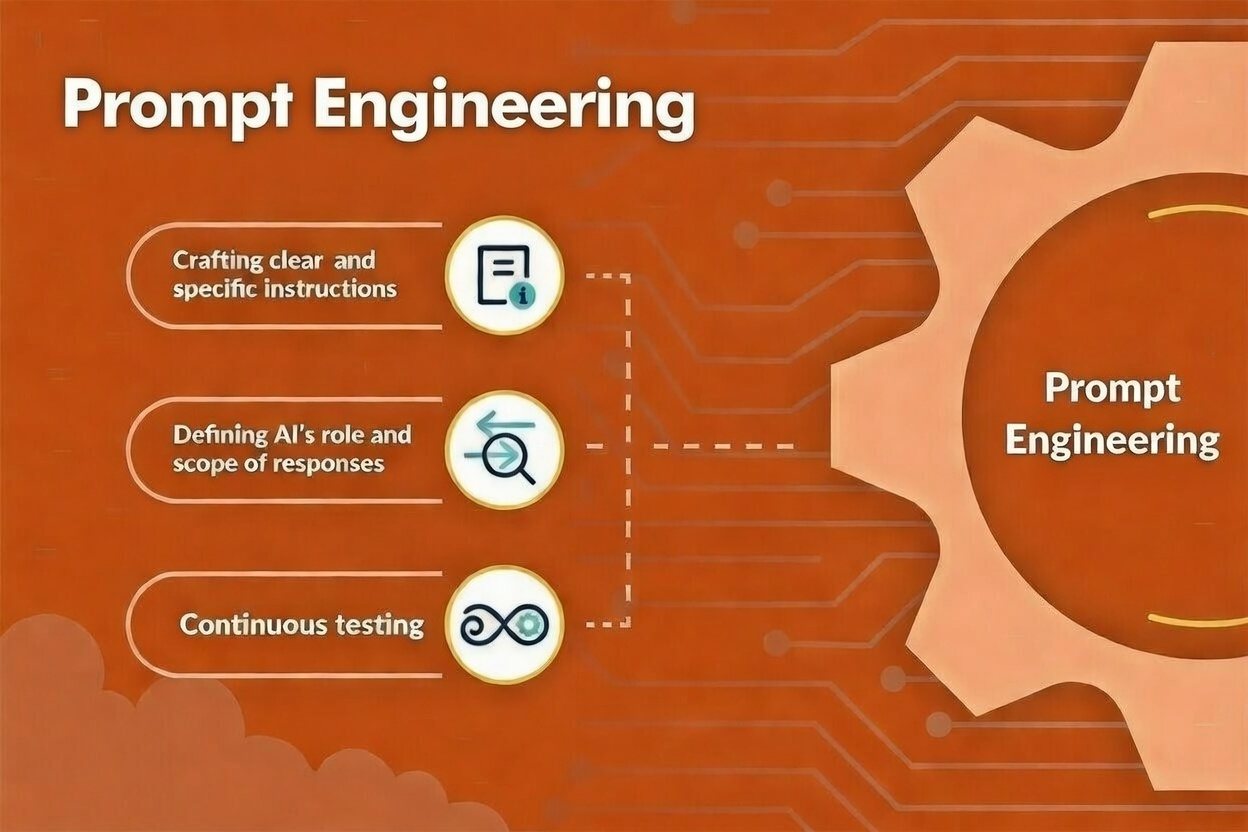
Prompt engineering is a sophisticated Natural Language Processing (NLP) methodology designed to optimize Large Language Model (LLM) performance by calibrating the input context and instructional parameters. It entails synthesizing structured prompts that function as high-level directives to generate precise and deterministic outputs.
While performance scaling can be achieved through fine-tuning, distillation, or migrating to higher-parameter architectures, prompt optimization represents the most agile and cost-effective path toward production-ready AI systems.
Heuristics for Effective Input Design
- Precision & Clarity: Avoid ambiguity to reduce output noise.
- Contextual Exemplars: Use few-shot examples to guide response distribution.
- Iterative Variance: Test diverse prompt styles and formats.
- Empirical Refinement: Benchmark variants and inject granular detail.
- Human-in-the-Loop: Continuously refine through feedback telemetry.
Control Mechanisms
Prompts operate as programmable interfaces for AI systems. Control mechanisms include stylization, structural formatting, and logic restrictions.
- Stylization: Define tone, persona, or communication register.
- Structural Formatting: Enforce JSON, bullet lists, or schema constraints.
- Logic Restrictions: Apply constraints such as date filters or abstention logic.
Prompting Methodologies
- Zero-Shot: Task execution without examples.
- Few-Shot: Provide N examples for improved accuracy.
- Persona-Based Prompting: Assign domain-specific roles.
- Chain-of-Thought (CoT): Encourage step-by-step reasoning.
- Self-Consistency: Generate multiple reasoning paths and majority-vote outputs.
Advanced Augmentation
- Retrieval-Augmented Generation (RAG): Inject external knowledge sources into prompts.
- Output Token Optimization: Eliminate conversational filler for SaaS automation.
- Program-Aided Language (PAL): Use code execution for arithmetic precision.
- Hallucination Mitigation: Enforce contextual grounding and constraint logic.
As AI systems evolve, prompt engineering remains the most agile and infrastructure-efficient mechanism for optimizing performance, reducing hallucinations, and enabling scalable SaaS integration.
.png)